


Proteins, also known as polypeptides, are organic compounds made up of amino acids. They’re large, complex molecules that play many critical roles in the body.
Proteins are made up of hundreds of thousands of smaller units that are arranged in a linear chain and folded into a globular form. There are 20 different types of amino acids that can be combined to make a protein and the sequence of amino acids determines each protein’s unique 3-dimensional structure and its specific function.
Proteins do most of the work in cells and are required for the structure, function, and regulation of the body’s tissues and organs. Essential parts of organisms, they participate in virtually every process within cells. Many proteins are enzymes that catalyse biochemical reactions and are vital to metabolism. The size of a protein is an important physical characteristic and scientists often use particle size analysers in their studies to discuss protein size or molecular weight.
To be able to perform their biological function, proteins fold into one or more specific spatial conformations driven by a number of non-covalent interactions such as hydrogen bonding, ionic interactions, Van der Waals forces, and hydrophobic packing. This understanding is the topic of the scientific field of structural biology, which employs traditional techniques such as X-ray crystallography, NMR spectroscopy, and Circular Dichroism spectrometry to determine the structure of proteins.
Most proteins fold into unique three-dimensional structures. The shape that a protein folds into naturally is known as its native conformation. While most proteins can fold unassisted through the chemical properties of their amino acids, others require the aid of molecular chaperones. There are four distinct aspects of a protein’s structure:
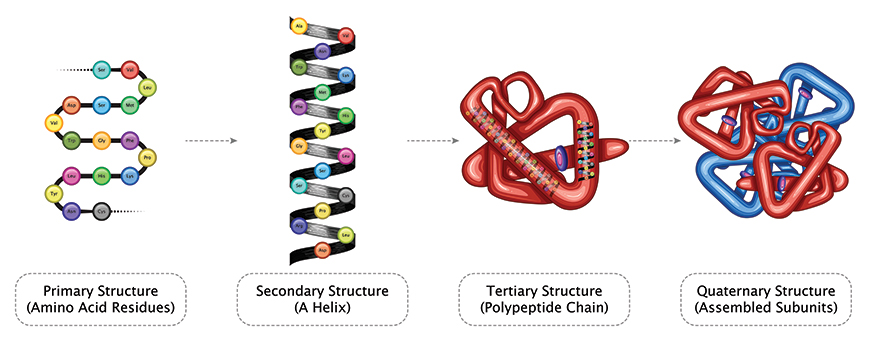
Protein structures range in size from tens to several thousand amino acids. By physical size, proteins are classified as nanoparticles, between 1 – 100nm. Very large aggregates can be formed from protein subunits. For example, many thousand actin molecules assemble into a microfilament.
Proteins differ from each other according to the type, number and sequence of amino acids that make up the polypeptide backbone. Hence, they have different molecular structures, nutritional attributes and physicochemical properties.

 Enquire Now
 +91 999 5338853
 +968 99312306
 techdirector@tracezglobal.com

 Non-Technical Programs